These figures on the food crisis are quite incredible. The price of wheat has risen 130% since March last year. The increase in the price of rice has had huge effects worldwide.
Some of the effects to be caused by the crisis include a new craze for eating spaghetti in Liberia, families in Bangladesh surviving on one meal a day, 100 million extra families plunged into poverty, and food riots in Haiti, Cameroon, Indonesia and Egypt.
Read the BBC's Q&A on the crisis.
If ever there was a good reason to become a vegetarian, this is one.
Tuesday, April 29, 2008


How fixed is the script?
I was interested to read Ben Witherington's view on God's 'script' and the significance of human decisions.
"Let your kingdom come, your will be done..."
Another interesting link I came across on Ben's blog is a 'blogalogue' between Bart Ehrman and N. T. Wright on the problem of suffering. Ehrman has just published a book called 'God’s Problem: How the Bible Fails to Answer Our Most Important Question – Why We Suffer'. NT Wright is as eloquent and graceful in his replies as ever. I always find him refreshing on this subject as he takes the existence of evil seriously and isn't content to attribute all suffering in the world to human choices.
"Whilst, God could have done otherwise, he has chosen to allow us to be viable partners with God in ministry and the working out of his will and Kingdom on earth, beings capable of making un-predetermined choices that have incredible consequences. The issue is not the sovereignty of God - the issue is how God has chosen to exercise his power and will. And what the Bible says about this is that he has not pre-determined all things from before the foundations of the world.I absolutely agree. Saying that God always gets his way makes no sense of Jesus' instructions on prayer, in particular the Lord's prayer:
Human history is not merely a preordained play, played out perfectly to a pre-ordained script. On the contrary while there is a blue-print, or a general script, God has allowed, indeed invited us to make the drama like a night at the Improv, improvising our roles as we go, and making viable choices of moment and consequence along the way. Are we supposed to follow the general instructions in the script? Well yes, as they provide the boundaries beyond which we ought not to go and show us what character and kind of roles we should play. But of course we may fail to play our parts well, or indeed at all."
"Let your kingdom come, your will be done..."
Another interesting link I came across on Ben's blog is a 'blogalogue' between Bart Ehrman and N. T. Wright on the problem of suffering. Ehrman has just published a book called 'God’s Problem: How the Bible Fails to Answer Our Most Important Question – Why We Suffer'. NT Wright is as eloquent and graceful in his replies as ever. I always find him refreshing on this subject as he takes the existence of evil seriously and isn't content to attribute all suffering in the world to human choices.
"...the Gospels constituted, and still constitute, a challenge to all expectations, particularly in that they link – as readers for hundreds have years have found it difficult to do – the story of Jesus’ kingdom-inauguration with the story of his crucifixion and resurrection. Somehow, they are saying, this is what it looks like when the good, all-powerful and all-loving God is in charge of the world. You may say that if this is what they’re saying then the God of whom they speak is not ‘all-powerful’ in the way we might have imagined, and I suspect that is in a sense correct. Near the heart of Jesus’ proclamation lies a striking redefinition of power itself, which looks as though it’s pointing in the direction of God’s ‘running of the world’ (if that’s the right phrase) in what you might call a deliberately, almost studiedly, self-abnegating way, running the world through an obedient, and ultimately suffering, human being, with that obedience, and especially that suffering, somehow instrumental in the whole process. What ‘we would want God to do’ – to have God measure up to our standards of ‘how a proper, good and powerful God would be running the world’! – seems to be the very thing that Jesus was calling into question.
The mystery of Jesus himself, then, is for me near the heart of – not ‘the answer’, because I don’t think there is such a thing as ‘the answer’, but – the matrix of thought and life within which God’s people are called to continue to grapple with the problem. This is where, in Evil and the Justice of God, I try to draw together traditional discussions of ‘the atonement’ and traditional discussions of ‘the problem of evil’ and suggest that it’s odd that they should ever have been separated, since they seem to go together so closely in the Bible itself. (And can’t be reduced, I suggest, to the ‘God punishes sin’ logic; I have tended to include some elements of that within the Christus Victor motif, which, yes, involves suprahuman cosmic powers and all that. Hard though they are to describe adequately, they are even harder, in my view, to ignore.)"
Wednesday, April 23, 2008
Clip clip and away
How did I survive so long without an MP3 player? I've wanted one for years, but just kept putting off the crucial decision. Now, finally, I have my very own shiny red, matchbook-size 2GB player and I'm quite addicted to its charms.
The player that's captured my heart is the Sansa Clip 2GB with Radio - the red version, of course!
After first being drawn to its shiny red gorgeousness and miniature proportions and then charmed by its helpful little screen and friendliness to others (computers and software alike), you could now say I'm looking forward to a comfortable, committed future together...
It has a fantastic inbuilt clip - thus the name - which has proven really useful at the gym, the good sense to keep your place in an audio book even when you switch over to listen to something else, a radio, sensible controls, easy volume adjustment and it sounds great!
[advert over] :-)
I've also rediscovered audio books. Not a cheap option compared to a book, but what a treat! I signed up to Audible for a couple of months and this may be a new addiction! I listened to The Hobbit (unabridged) first - all 12 or so hours of it. Absolutely brilliant! For days you couldn't get much sense out of me at all, it was all 'What has he got in his pocketsess?' and 'the eagles! the eagles!'
My second find, and another treasure, has been Tim Butcher's Blood River, read by the author. In 2004 Tim, a correspondent for the Daily Telegraph, made his way alone across one of the most dangerous countries in the world, the Congo, inspired to follow the route of the famous explorer HM Stanley. This is his account of the adventure, the people he met and the history of this apparently doomed country. Obsessed, yes; crazy, probably. Yet this is a fantastic tale and a deeply provoking and affecting account of the present-day Congo and the forces which have shaped it and continue to do so. Thoroughly recommended.
Sunday, April 13, 2008
No Lions...
I really enjoyed this story in the Guardian about the Maasai Warriors running in the London Marathon and their thoughts on England.
The Telegraph also has some great quotes from the guide to England they were given.
We heard about showers before, in a briefing about the country. It said be careful - when the shower is hot it is really hot, and when cold, really cold. This is true.
The Telegraph also has some great quotes from the guide to England they were given.
Monday, March 31, 2008
Design for the Other 90%
The title of this post comes from a recent design exhibition - with a difference. As the exhibition website explains,
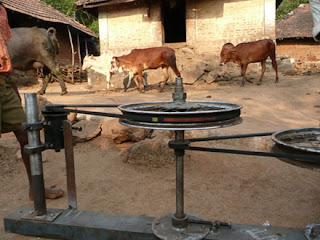
I've long been fascinated by the development of the One Laptop Per Child project, its 'first principles' approach and the way in which OLPC have turned every assumption about building laptops on its head. There's an excellent video of the designer Mary Lou Jepsen at the Greener Gadgets show explaining the many innovations that have gone into the XO laptop and why it's not only low-cost and fit-for-purpose, but also amazingly 'green' as well. In fact, as she explains, it could not have been otherwise: the design had to be low energy and 'green' in order to survive in an environment where energy is at a premium. There's a great section about innovative charging methods including (my favourite) the cow-charger! I completely get her excitement - so many elements of this design are worth raving about!
Of the many design solutions being profiled on these websites, some of my other favourites include the LifeStraw, a personal water-filtration and purification device, the weird but ingeneous Stenop Low-Cost Correcting Glasses, and the simple but effective Hippo Roller!

Classic ideas also seeing a new lease of life include the Solar Oven, the WaterCone, a solar-powered water desalinator, and the Portable Light Project, which makes use of the new high-brightness LEDs.
What 'Other 90%' or 'Green' design ideas have caught your eye recently?
Of the world’s total population of 6.5 billion, 5.8 billion people, or 90%, have little or no access to most of the products and services many of us take for granted; in fact, nearly half do not have regular access to food, clean water, or shelter. Design for the Other 90% explores a growing movement among designers to design low-cost solutions for this 'other 90%.' Through partnerships both local and global, individuals and organizations are finding unique ways to address the basic challenges of survival and progress faced by the world’s poor and marginalized.There are some fantastic ideas being showcased here, both ingenious and simple. Other websites celebrating designs for the developing world include the INDEX award, the Project H Design site, and the blog TreeHugger, among others.
I've long been fascinated by the development of the One Laptop Per Child project, its 'first principles' approach and the way in which OLPC have turned every assumption about building laptops on its head. There's an excellent video of the designer Mary Lou Jepsen at the Greener Gadgets show explaining the many innovations that have gone into the XO laptop and why it's not only low-cost and fit-for-purpose, but also amazingly 'green' as well. In fact, as she explains, it could not have been otherwise: the design had to be low energy and 'green' in order to survive in an environment where energy is at a premium. There's a great section about innovative charging methods including (my favourite) the cow-charger! I completely get her excitement - so many elements of this design are worth raving about!

Of the many design solutions being profiled on these websites, some of my other favourites include the LifeStraw, a personal water-filtration and purification device, the weird but ingeneous Stenop Low-Cost Correcting Glasses, and the simple but effective Hippo Roller!
Classic ideas also seeing a new lease of life include the Solar Oven, the WaterCone, a solar-powered water desalinator, and the Portable Light Project, which makes use of the new high-brightness LEDs.
"The majority of the world’s designers focus all their efforts on developing products and services exclusively for the richest 10% of the world’s customers. Nothing less than a revolution in design is needed to reach the other 90%."Another design site I've enjoyed recently is the Houses of the Future project - check out the cardboard house!
—Dr. Paul Polak, International Development Enterprises (link)
What 'Other 90%' or 'Green' design ideas have caught your eye recently?
Friday, March 21, 2008
What I know
I've been listening to Greg Boyd's recent sermons on prayer - inspiring and thought-provoking, as ever. Hopefully I'll get round to blogging further on my thoughts and response to these. But, listening to his sermon on the variables that affect answers to prayer ('Scorpions, Eggs and Prayer') I've been particularly reflecting on his explanation of what we DON'T know, that is almost everything! He explains that it's profoundly important to know what we don't know and to get comfortable saying 'I don't know'. As he memorably describes it, we "swim in an infinite sea of unknowability" and what we call the 'things we know' is an oasis of pseudo-knowledge floating in a sea of mystery! It is knowing this that keeps us from being sucked into formulas and trite responses.
I completely agree with him that the statement 'I don't know' can be enormously powerful in the right context. When faced with the question of suffering, I wonder whether it is indeed the only appropriate answer. It rings true with God's response to Job - there is far more in the Universe than you could possibly know or understand. There is a necessary humility when faced with the question of why a prayer has not been answered. Although it may ease our pain to find someone to blame, any answer cannot help but be simplistic and damaging - either to ourselves or others, or to our relationship with God.
However, while we may have to answer 'I don't know', this cannot be the end of our response. We are called to have compassion - and words may only be a small part of this. And as Christians we also have hope.
There is much we don't know, but one thing I do know: Jesus our Saviour was dead in the grave, and is alive again! Jesus is alive - that is the response of hope.
Happy Easter everyone!
I completely agree with him that the statement 'I don't know' can be enormously powerful in the right context. When faced with the question of suffering, I wonder whether it is indeed the only appropriate answer. It rings true with God's response to Job - there is far more in the Universe than you could possibly know or understand. There is a necessary humility when faced with the question of why a prayer has not been answered. Although it may ease our pain to find someone to blame, any answer cannot help but be simplistic and damaging - either to ourselves or others, or to our relationship with God.
However, while we may have to answer 'I don't know', this cannot be the end of our response. We are called to have compassion - and words may only be a small part of this. And as Christians we also have hope.
There is much we don't know, but one thing I do know: Jesus our Saviour was dead in the grave, and is alive again! Jesus is alive - that is the response of hope.
"I am the Living One; I was dead, and behold I am alive for ever and ever! And I hold the keys of death and Hades."
Revelation 1.18
Happy Easter everyone!
Tuesday, March 18, 2008
John Piper on the Prosperity Gospel
This a superb video highlighting comments by John Piper on the 'Prosperity Gospel' message speaking in Birmingham in 2005.
Those are full-on words, but I think he's essentially got it right.
N.B. The story he tells about the car crash happened to someone in his church.
Those are full-on words, but I think he's essentially got it right.
N.B. The story he tells about the car crash happened to someone in his church.
Friday, February 22, 2008
Heroes!
A recent, and most delightful, discovery has been the TV series 'Hornblower'. Completely fantastic! The adventures, the wit and derring-do, the honour, duty and courage, the twinkle in his eye, the floppy hair.... Where have I been since 1998? - or was it 1798?
I'm not sure whether to read the books or not - Ioan Gruffudd is so perfect in the TV series that it's hard to imagine anything different!

I knew by the end of the first episode that Horatio Hornblower would be joining my 'list' of favourite fictional characters. But it got me thinking as to who else might also be on it!
So here goes, my first draft at a list of favourite fictionalcharacters heroes:
In no particular order,
Horatio Hornblower (as played by Ioan Gruffudd)
Captain Jean Luc Picard
Constable Benton Fraser (Due South)
President Bartlett (plus the rest of the cast of The West Wing!)
Mr Spock
Anne Shirley (as played by Megan Follows)
Jo March (Little Women)
Aragorn (Viggo Mortensen gets it!) - plus Gandalf, Legolas and the others!
Sir Lancelot
On the B list are:
King Arthur (Sean Connery's, obviously)
Robin Hood (I think Kevin Costner's wins)
Spiderman (Tobey Maguire) - he's so sweet!
Mr Darcy (hmm, difficult to decide which one)
Princess Leah, Han Solo and Luke Skywalker
Buffy Summers
Captain Carrot (from the Terry Pratchett books!)
Sherlock Holmes
Elinor Dashwood
Hmm, I notice they're almost all TV characters so far! And by far the majority, men :) And a good number of men in uniform as well... I'm so predictable...hehe.
I'm sure I need some more 'intellectual' choices... any suggestions, anyone?
I'm not sure whether to read the books or not - Ioan Gruffudd is so perfect in the TV series that it's hard to imagine anything different!
I knew by the end of the first episode that Horatio Hornblower would be joining my 'list' of favourite fictional characters. But it got me thinking as to who else might also be on it!
So here goes, my first draft at a list of favourite fictional
In no particular order,
Horatio Hornblower (as played by Ioan Gruffudd)
Captain Jean Luc Picard
Constable Benton Fraser (Due South)
President Bartlett (plus the rest of the cast of The West Wing!)
Mr Spock
Anne Shirley (as played by Megan Follows)
Jo March (Little Women)
Aragorn (Viggo Mortensen gets it!) - plus Gandalf, Legolas and the others!
Sir Lancelot
On the B list are:
King Arthur (Sean Connery's, obviously)
Robin Hood (I think Kevin Costner's wins)
Spiderman (Tobey Maguire) - he's so sweet!
Mr Darcy (hmm, difficult to decide which one)
Princess Leah, Han Solo and Luke Skywalker
Buffy Summers
Captain Carrot (from the Terry Pratchett books!)
Sherlock Holmes
Elinor Dashwood
Hmm, I notice they're almost all TV characters so far! And by far the majority, men :) And a good number of men in uniform as well... I'm so predictable...hehe.
I'm sure I need some more 'intellectual' choices... any suggestions, anyone?
Thursday, February 21, 2008
From West Wing to the Real Thing
... so states the headline of an article on Barack Obama in today's Guardian. I'm glad I'm not the only person getting confused between The West Wing and the real world of US Politics!
It turns out that Matthew Santos, the 'next' president in The West Wing, was in fact modelled on Barack Obama - way back in 2004. As the article states, "the result is a bizarre case of art imitating life - only for life to imitate art back again."
It turns out that Matthew Santos, the 'next' president in The West Wing, was in fact modelled on Barack Obama - way back in 2004. As the article states, "the result is a bizarre case of art imitating life - only for life to imitate art back again."
In the TV show, Santos begins as the rank outsider up against a national figure famous for standing at the side of a popular Democratic president. There are doubts about Santos's inexperience, having served just a few years in Congress, and about his ability to persuade voters to back an ethnic minority candidate - even as his own ethnic group harbour suspicions that he might not identify with them sufficiently.
But the soaring power of his rhetoric, his declaration that the old divisions belong in the past and his sheer magnetism, ensure that he comes from behind in a fiercely close primary campaign and draws level with his once all-commanding opponent. Every aspect of that storyline has come true for Barack Obama. Axelrod, now chief strategist for the Obama campaign, recently joked in an email to Attie: "We're living your scripts!"
The Telegraph also found a list of 'delicious parallels' between The West Wing and the US Presidential Election.
Could this be how it ends? :-)
Matthew Santos' stirring convention speech (from 'The West Wing'):
Sunday, February 17, 2008
Music and Mortality
I found myself inspired today to re-read the Narnia series again. I had a wonderful time reading - and blogging about - the series a couple of years ago, but it's the kind of reading feeding material that deserves a regular visit I think.
So I sat down - or rather lay down - this afternoon with the Magician's Nephew. I'm a quick reader, but I forced myself to slow down, almost reading aloud, for the many beautiful passages describing the creation of Narnia. I could almost hear Aslan's voice singing Narnia into being, then the stars joining in, and the shear fruitfulness of the ground that cannot help but respond. My whole mind and body responds even to the thought of that singing, with recognition and joy, like a forgotten memory. Singing, yes - Jesus! O to have been there - but then we will be next time!
Speaking of heavenly music, a recent discovery has been 'Spem in Alium' by Thomas Tallis (listen to it sung by the Tallis Scholars on YouTube). A truly beautiful choral piece, it requires 8 choirs of 5 parts each (40 singing parts in total) and is designed for a cathedral. Rich and complex yet pure and simple, the interweaving melodies are haunting then joyful; completely wonderful. I would absolutely love to go to a live performance of this - and would travel a fair distance - so if anyone hears of a performance anywhere, please let me know!
But back to the Magician's Nephew. There's a moment at the beginning of Narnia when Aslan 'calls' the Cabbie's wife and she suddenly appears, whisked away from the Earth in the middle of her laundry! I was shocked to discover my reaction to this event - what, give her no warning? but what if she wanted to bring something? say goodbye? - and forced to reflect on my own silliness (even as the questions raced through my mind, I was simultaneously appalled and amused!). But actually it was not the mortality question necessarily that rocked me, the fact that of course we can't take anything when we die, but actually the conviction that I am too attached to 'things'.
What 'thing' left on Earth could possibly matter when brought to this wonderful new place of Narnia - why should she need or miss anything when Aslan himself is there? I know this will be true when we meet Jesus and live with him on the new Earth, so why do I have this attachment to 'things' that have no lasting value? I couldn't even think of anything particular I might have wanted to pick up had it been me whisked away - it was a general sense of disattachment. I have had the general sense for a number of months now that I want to 'lighten the load' and get rid of some stuff, because I have too many things, so this was an encouragement to me that that's true. I want to lose some of the excess weight, tone up, lighten up, be more flexible, temporary, ready to leave... So it's going to be 'give away' season! (feel free to help out! :)
Wednesday, January 30, 2008


Quote from The Silver Chair (or John 6.44!)
"You would not have called to me unless I had been calling to you," said the Lion.
"Then you are Somebody, Sir?" asked Jill.
"I am."
Tuesday, November 27, 2007


Saturday, November 24, 2007
Smiling Jesus

I really love this picture for some reason. The children and the women are lovely - and Jesus has such an amazing smile. He's totally in the moment and you can completely understand why they love him! The picture just makes me grin and grin when I look at it!
Thursday, November 22, 2007
EUGENE PETERSON on Well-Worn Paths
"Christians tramp well-worn paths: obedience has a history.
"This history is important, for without it we are at the mercy of whims. Memory is a databank we use to evaluate our position and make decisions. With a biblical memory we have two thousand years of experience from which to make the off-the-cuff responses that are required each day in the life of faith. If we are going to live adequately and maturely as the people of God, we need more data to work from than our own experience can give us. ...
"A Christian who has David in his bones, Jeremiah in his bloodstream, Paul in his fingertips and Christ in his heart will know how much and how little value to put on his own momentary feelings and the experience of the last week. ...
"What we require is obedience - the strength to stand and the willingness to leap, and the sense to known when to do which. Which is exactly what we get when an accurate memory of God's ways is combined with a lively hope in his promises."
From 'A Long Obedience in the Same Direction' by Eugene Peterson
God IN the story
I've been struck recently on the amazingness of 'God IN the story'. That it makes no sense at all to talk about God being 'unchanging' - partly because of the compassion issue - but primarily because of the incarnation. God is not so 'outside' time to the extent that it makes nonsense of the fact that at a particular time in history he changed in his very being... humanity has been 'added' to God (thus says the orthodox doctrine of the Trinity!). Yes, God's character has not changed, but fundamentally something has been added to his very being and importantly this has happened IN history. Wow!
Atonement ...further remarks
Here are a couple of things I've been reminded about in looking at the different theories of the atonement recently. I've called them 'things to keep in mind'.
Substitutionary Penal Atonement
In talking about the Father’s wrath on the Son it is important not to draw too firm a line between them. God takes sin on himself and suffers his own judgement in the person of Jesus. Ultimately God satisfies himself.
Christus Victor
It is important to remember that in talking about the triumph of Jesus over the powers of evil, that this is not a military triumph, a triumph of violence over violence, but a triumph of love. This kind of love is something that evil cannot understand… thus the powers are ‘disarmed’.
Monday, November 19, 2007
The Atonement and onwards
As I mentioned in my last post, I've recently been considering some aspects of the atonement and the different ways of explaining what God has done for us in the cross and resurrection of Jesus Christ.
In recent years I have become more sympathetic to the 'Christus Victor' theme as a way as describing in a cosmic sense what Jesus accomplished in his death and resurrection. In the context of this overarching triumph over the forces of evil, there are clearly many aspects to what Jesus' death means for us in particular. He took on himself the punishment for our rebellion against God and our evil deeds (penal substition), he paid the price (took the full consequences) for our sin ("the wages of sin is death" Rom 6.23), he died and rose again that we might have new life in him, he closed the book on the old covenant (see Romans 7)... and so on.
However, my recent re-reading of the NT and OT texts has given me lots of new things to ponder (some of which I hope to return to in later posts), and I am currently pursuing some avenues of thought in the OT (about blood if you want to know!). In my short investigation so far, none of the standard ways of speaking about the atonement (except for the most straightforward - e.g. 'Jesus died in my place'), have not felt entirely satisfactory, not quite telling the whole story. My hope, and it is a naive one perhaps, is that I will find a way to construct for myself a way of talking about the atonement that relies on Biblical language and reflects as best I can the fullness, and yet simplicity, of what God has done for us in Jesus' death and resurrection. I cannot pretend that I expect to complete this search but I'm sure it will be an interesting journey!
In my wanderings, I aim to keep three markers in sight. Firstly, I will keep foremost in my mind's eye a vision of the cross that once held the creator and saviour of the universe - but is now empty. In this I hope to follow Paul's insistence in 1 Corinthians 15 that "If Christ has not been raised... you are still in your sins."
Secondly, I shall keep my eye to the picture of Jesus that we have in Revelation chapter 5.
Finally, I will strive to keep in mind Paul's warnings about 'earthly wisdom' in 1 Corinthians 1. Ultimately it's not a question of wisdom, but of power: while the cross seems like foolishness to those that are perishing, to us who are being saved it is the power of God. At the end of the day, as my friend Archie says, 'It works'.
In recent years I have become more sympathetic to the 'Christus Victor' theme as a way as describing in a cosmic sense what Jesus accomplished in his death and resurrection. In the context of this overarching triumph over the forces of evil, there are clearly many aspects to what Jesus' death means for us in particular. He took on himself the punishment for our rebellion against God and our evil deeds (penal substition), he paid the price (took the full consequences) for our sin ("the wages of sin is death" Rom 6.23), he died and rose again that we might have new life in him, he closed the book on the old covenant (see Romans 7)... and so on.
However, my recent re-reading of the NT and OT texts has given me lots of new things to ponder (some of which I hope to return to in later posts), and I am currently pursuing some avenues of thought in the OT (about blood if you want to know!). In my short investigation so far, none of the standard ways of speaking about the atonement (except for the most straightforward - e.g. 'Jesus died in my place'), have not felt entirely satisfactory, not quite telling the whole story. My hope, and it is a naive one perhaps, is that I will find a way to construct for myself a way of talking about the atonement that relies on Biblical language and reflects as best I can the fullness, and yet simplicity, of what God has done for us in Jesus' death and resurrection. I cannot pretend that I expect to complete this search but I'm sure it will be an interesting journey!
In my wanderings, I aim to keep three markers in sight. Firstly, I will keep foremost in my mind's eye a vision of the cross that once held the creator and saviour of the universe - but is now empty. In this I hope to follow Paul's insistence in 1 Corinthians 15 that "If Christ has not been raised... you are still in your sins."
Secondly, I shall keep my eye to the picture of Jesus that we have in Revelation chapter 5.
"See, the Lion of the tribe of Judah...has triumphed!"I am convinced that no doctrine of the atonement can be complete unless it embraces fully the picture of Jesus we see in these verses: both triumphant Lion and slain Lamb.
Then I saw a Lamb, looking as if it had been slain, standing in the centre of the throne...
Finally, I will strive to keep in mind Paul's warnings about 'earthly wisdom' in 1 Corinthians 1. Ultimately it's not a question of wisdom, but of power: while the cross seems like foolishness to those that are perishing, to us who are being saved it is the power of God. At the end of the day, as my friend Archie says, 'It works'.
Saturday, November 03, 2007
The Widow and the King
I've just finished re-reading 'The Widow and the King' by John Dickinson, a teenage medieval fantasy that my brother Leo bought me a couple of years back. We both read and enjoyed his first book, 'The Cup of the World' and then had to read the sequel. They're a great couple of books, engaging and intelligent, and I'm always left with plenty to think about.
'The Widow and the King' is about a boy's escape from, and finally battle against, an enemy he variously calls the 'Heron Man' or 'The Prince Under the Sky'*. The Prince is a formidable and very creepy enemy who is always working in the background, whispering in peoples' ears, bringing down kings and corrupting the wise, bringing despair and destruction. It's not hard to see why I found in this book a worldview I could understand! The book is really quite scary at times, and there is a coherent (and occasionally heartbreaking) inevitability to the character development.
(*this works well as a title for Satan doesn't it?)
This is ultimately a story of good against evil. The boy, Ambrose, is the son of a previous king and an obvious heir. He tries to do the right thing, but he's innocent of the realities of the world he lives in. The book tells the story of his journey to wisdom, whilst at the same time vindicating him in his innocence and goodness. Of course we know that, in this book as well as in life, goodness will conquer evil in the end, but in the meantime, the Prince is depressingly successful in his destructive and corrupting aims.
One of the major and most compelling themes in the book is the theme of forgiveness. Ambrose is convinced that forgiveness is necessary and that a king must have mercy. He argues this out with Aun, who knows by experience that a king who forgives an enemy instead of destroying him may suffer the consequences:
I've been thinking a lot about atonement recently and I'll probably be posting some of my reflections this week.. so until then.
'The Widow and the King' is about a boy's escape from, and finally battle against, an enemy he variously calls the 'Heron Man' or 'The Prince Under the Sky'*. The Prince is a formidable and very creepy enemy who is always working in the background, whispering in peoples' ears, bringing down kings and corrupting the wise, bringing despair and destruction. It's not hard to see why I found in this book a worldview I could understand! The book is really quite scary at times, and there is a coherent (and occasionally heartbreaking) inevitability to the character development.
(*this works well as a title for Satan doesn't it?)
This is ultimately a story of good against evil. The boy, Ambrose, is the son of a previous king and an obvious heir. He tries to do the right thing, but he's innocent of the realities of the world he lives in. The book tells the story of his journey to wisdom, whilst at the same time vindicating him in his innocence and goodness. Of course we know that, in this book as well as in life, goodness will conquer evil in the end, but in the meantime, the Prince is depressingly successful in his destructive and corrupting aims.
One of the major and most compelling themes in the book is the theme of forgiveness. Ambrose is convinced that forgiveness is necessary and that a king must have mercy. He argues this out with Aun, who knows by experience that a king who forgives an enemy instead of destroying him may suffer the consequences:
"And as for forgiving - it's not free, not even for a king. It's like taking on debt. And a king who forgives too much pays with his life. Remember that."There are so many interesting subthemes in the books, and half-references to a worldview which makes sense to me, that I'd probably be surprised if John Dickinson was not a Christian. But if he isn't - he's stumbled on some significant truths about the world. CS Lewis talks about all stories reflecting something of the 'BIG Story', so perhaps that's what's happened here.
I've been thinking a lot about atonement recently and I'll probably be posting some of my reflections this week.. so until then.
Thursday, September 20, 2007
War Poetry
I've been reading poetry. I discovered a book of metaphysical poetry on Seymour's bookshelf and I've been enjoying some more John Donne, although my favourite remains his sonnet 'Batter my heart'.
On the Today programme this morning I listened to Brian Turner reading his striking poem 'Here, Bullet', written while serving in the American army in Iraq in 2003. You can listen to him read it on the Fishouse (sic) website.
Finally, this evening I came across 'The Sorrow of God' by Geoffrey Studdert Kennedy on Ben Witherington's blog. Like Job, but with the insight of the cross, this is one poem I'll be going back to.
There's nothing quite like poetry for expressing truth...
On the Today programme this morning I listened to Brian Turner reading his striking poem 'Here, Bullet', written while serving in the American army in Iraq in 2003. You can listen to him read it on the Fishouse (sic) website.
Finally, this evening I came across 'The Sorrow of God' by Geoffrey Studdert Kennedy on Ben Witherington's blog. Like Job, but with the insight of the cross, this is one poem I'll be going back to.
"So it isn't just only the crown of thorns
What has pierced and torn God's head
He knows the feel of the bullet too,
And he's had his touch of the lead."
There's nothing quite like poetry for expressing truth...
Subscribe to:
Posts (Atom)

