Showing posts with label science. Show all posts

Monday, March 31, 2008

Design for the Other 90%

The title of this post comes from a recent design exhibition - with a difference. As the exhibition website explains,
Of the world’s total population of 6.5 billion, 5.8 billion people, or 90%, have little or no access to most of the products and services many of us take for granted; in fact, nearly half do not have regular access to food, clean water, or shelter. Design for the Other 90% explores a growing movement among designers to design low-cost solutions for this 'other 90%.' Through partnerships both local and global, individuals and organizations are finding unique ways to address the basic challenges of survival and progress faced by the world’s poor and marginalized.
There are some fantastic ideas being showcased here, both ingenious and simple. Other websites celebrating designs for the developing world include the INDEX award, the Project H Design site, and the blog TreeHugger, among others.

I've long been fascinated by the development of the One Laptop Per Child project, its 'first principles' approach and the way in which OLPC have turned every assumption about building laptops on its head. There's an excellent video of the designer Mary Lou Jepsen at the Greener Gadgets show explaining the many innovations that have gone into the XO laptop and why it's not only low-cost and fit-for-purpose, but also amazingly 'green' as well. In fact, as she explains, it could not have been otherwise: the design had to be low energy and 'green' in order to survive in an environment where energy is at a premium. There's a great section about innovative charging methods including (my favourite) the cow-charger! I completely get her excitement - so many elements of this design are worth raving about!


Of the many design solutions being profiled on these websites, some of my other favourites include the LifeStraw, a personal water-filtration and purification device, the weird but ingeneous Stenop Low-Cost Correcting Glasses, and the simple but effective Hippo Roller!


Classic ideas also seeing a new lease of life include the Solar Oven, the WaterCone, a solar-powered water desalinator, and the Portable Light Project, which makes use of the new high-brightness LEDs.

"The majority of the world’s designers focus all their efforts on developing products and services exclusively for the richest 10% of the world’s customers. Nothing less than a revolution in design is needed to reach the other 90%."
—Dr. Paul Polak, International Development Enterprises (link)

Another design site I've enjoyed recently is the Houses of the Future project - check out the cardboard house!

What 'Other 90%' or 'Green' design ideas have caught your eye recently?

Wednesday, February 21, 2007

Reading Genesis after Darwin

I attended a fascinating series of lectures today, hosted by the Theology Department and the Institute of Advanced Study (IAS) here at Durham, on science and theology, specifically looking at the impact of Darwin on theology - and on the reading of Genesis in particular. This is part of an ongoing series of interdisciplinary lectures put on by the IAS, which this year is looking at The Legacy of Charles Darwin.

I made it to four out of the five lectures today, all of which were extremely stimulating and covered a range of topics from Paley to Dawkins and Augustine to Koko the Chimp.

I've left with a range of responses to the different ideas presented, and plenty of questions. I'm left pondering the nature and status of evil, the pervasiveness of the 'God of the Gaps' and Deism, the significance of rationality and language in apes, the place of humans in the natural world...

Here's a selection of the some of the ideas presented today (some I agree with more than others):

o Does the idea that creation must have been instantaneous have more to do with a Deist God who creates the universe and then "goes off to have a cup of tea" than with the God of the Bible? (DW)

o Perhaps drawing the line between humans and animals on the basis of rationality, language or other qualitative differences is a 'God of the Gaps' approach. Are all of these elements, including moral choices, just a matter of degree? (DC, JA)

DC discussed one particularly fascinating example, Koko the Gorilla. I also recently came across the story of N'kisi, an African Grey Parrot with a vocabulary of 950 words and the ability to form sentences and even to use humour.

o In the early church and beyond, the understanding of the incarnation has moved from 'God became a Jew' through 'God became a man' to 'God became a human'. Can this be taken further, to 'God became a Creature'*? (DC) [*I have some issues with this from a Biblical perspective..]

o The question of evil, in terms of suffering and death, is more complicated than we at first imagine when we look at nature. "Competition, struggle, suffering, death and extinction" appear to be completely entangled in the way that nature functions - in reproduction, predation, life cycles, adaptation, evolution and so on.. Intended or permitted? (JA)

o The universe is so complex that it makes little real difference on a practical level to distinguish between which models of deism / theistic evolution / God of the gaps you employ to explain the Creator's relationship with the Creation. The universe is just as complicated whether you believe that God is constantly acting at the level of quantum uncertainty or you think he created the laws which govern it 'at the beginning'. The point at which the question becomes important is the difference in what you expect from God. (JA)

One of the ideas which I thought was most interesting, was Prof. Jeff Astley's observation (borrowed from Holmes Rolston III), that evolution makes a necessity of waste and suffering. That every part of nature has a 'cruciform' shape, a passion play in which the innocent die so that many may live. As Rolston puts it, in this 'slaughter of the innocents' we have perhaps,

"vignettes hinting of the innocent lamb slain from the foundation of the world. They share the labor of the divinity. In their lives, beautiful, tragic and perpetually incomplete, they speak for God; they prophesy as they participate in the divine pathos. All have 'borne our griefs and carried our sorrows'." (Science and Religion: A Critical Survey, 1987, p.145)

This is Karl Barth on a similar theme:
"The suffering, by which the whole created world of men and things is controlled, is His, His action, His question, and His answer." (The Epistle to the Romans, ET 1933, p.309)

JA argued that 'errors' in DNA copying are a 'happy fault' when seen from a species-wide or planet-wide perspective. It's hard to argue with the sense that the "imperfections of the world are a driving force for its perfections". (JA)

I also liked Astley's description of the way in which the way we look at nature can be likened to a religious experience. He talked about the way that in viewing nature we are both attracted and repelled for it is both lovely and terrible. The proper response is a 'shudder of otherness', akin to our experience of God, to have both awe and fear.


Lots to ponder here I think!

[DW - Dr David Wilkinson, DC - Dr David Clough, JA - Prof Jeff Astley]

Monday, September 11, 2006

Sunshine + water =

Everyone knows about rainbows, but have you heard of Sun Dogs and ice halos, moonbows and glories? Atmospheric Optics is a fascinating site, dedicated to the beautiful results of sunshine with water droplets or ice crystals.

The site has some amazing photographs, some simple, some almost unbelievable. And although the optics/mathematics here is very involved, the basic physics of refraction and dispersion is relatively simple. it's incredible to think that such basic ingredients could combine to produce such beautiful and complex displays.

Tuesday, May 02, 2006

Mythical Method?

"The most exciting phrase to hear in science, the one that heralds new discoveries, is not 'Eureka!', but 'That's funny …'"

Isaac Asimov... speaking against the scientific method!

I have the quote on my wall in my lab, but sadly I continue to propagate ideas like these 10 Myths of Science.

Physics isn't for sensible people

I recently came across an old copy of Bluff your way in the Quantum Universe, a taster/guide that I picked up as a present a few years back and ended up keeping!

Quantum theory is the strangest stuff you've ever heard taken seriously. Its sheer weirdness makes it a favourite part of physics for me, despite the tricky maths that haunted the latter half of my degree.

This very short book serves as a fun introduction. Here's a taster:

"Quantum theory challenges, at the very least, notions of Causality, Predictability, Reversibility, Continuity, Locality, Order, Separateness (sometimes called Isolability), Clear Definition, Accurate and Informative Measurement, Objectivity, Either/or Thinking and, most controversially, Certainty. It threatens notions of solidity and substance, and suggests that there are absolutely no absolutes." (page 28)

It goes on to discuss each of these, but you'll have to borrow the book from me if you want to know what they're all about!

Thursday, April 06, 2006

The vote is open

I've finally finished selecting my 10 images of space and it's been fantastic to remind myself just how beautiful the universe is.

Some decisions were hard to make.. which nebulae would make it to the final cut?

Here's some images which were near-rejects:
Cygnus loop shockwave
Eskimo Nebula
Spiral galaxies collide
...and many others!

You may disagree with my choices, but all the images I chose have a particular significance.

I'm curious to know which are people's favourites and whether everyone has the same idea of beauty... Let me know your top 3 from the 10 images I've picked.

Wednesday, April 05, 2006

Mitochondria and Eve

National Geographic have launched the Genographic Project in an effort to trace the journey of human beings across the globe.

Tracing DNA history is an area of science in which I have been interested for a while, although biology is certainly not my specialism. Here's a short explanation, which will hopefully give a sense of why cellular biology plays such an interesting and important part in tracing human history.

Inside every cell of your body are tiny structures called organelles (the nucleus is the most well known). One of these organelles is the mitochondrion. Mitochondria are often called 'cellular power plants' for their role in providing energy to the cell.

However, these little structures are important for another reason. Mitochondria are unusual because they have their own DNA, their own genetic code, and it is generally accepted that their history began as a separate organism. If this is the case, then these creatures have a symbiotic relationship with humans. But this is just part of the story, although an intriguing part!

Mitochondria reproduce like bacteria, by division ('binary fission'), essentially making them clones. They reproduce according to the energy needs of the cell and therefore their life cycle is not related to the life cycle of the cell. During human reproduction an egg nucleus and a sperm nucleus are joined and their genetic material combined to form a new genetic code. However, the mitochondria in the sperm cell are generally destroyed at fertilisation and so the embryo begins its life with mitochondria from the mother only.

So that's the background, here's where it gets interesting... As mitochondria are basically clones, very little genetic difference is seen between successive human generations, although mutation over time will introduce markers that enable a particular 'gene tree' to be identified. This makes them particularly useful in population genetic studies, such as the National Geographic project mentioned above, because they allow scientists to use these markers to trace the movements of populations across many generations and recognise links between widely dispersed peoples (e.g. between Koreans and Native Americans - see the Atlas of the Human Journey).

Comparing differences between mtDNA and working backwards to find the point at which it diverged also uncovers "the woman who is the most recent common matrilineal ancestor of all living humans", famously named Mitochondrial Eve. The age of 'Eve' can be approximated using the 'gene clock' technique, a way of tracing the point when two population groups have diverged by counting the number of genetic differences between their DNA sequences. She is thought to have lived in Africa about 150,000 years ago. While there will have been other women living at the same time, many of whom will have descendants today, only Mitochondrial Eve produced an unbroken line of daughters that persists to this day.

Controversial for some, perhaps, but certainly interesting - don't you agree?

Tuesday, April 04, 2006

10 beautiful things...

...to see in space!

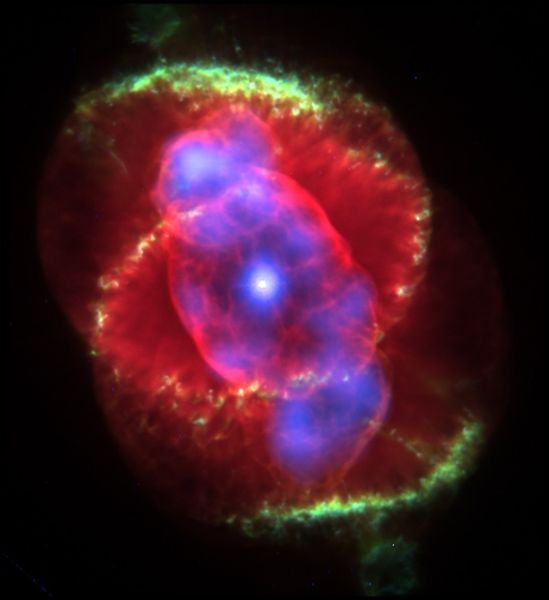
1. Cat's Eye Nebula


2. Earthrise (taken by Apollo 8) - from NASA Historical Images


3. Gas pillars in Eagle Nebula (M16)


4. Hubble Ultra Deep Field (HUDP)
This picture looks back in time 13 billion years and despite covering a tiny fraction of the sky (3 arc minutes square) includes 10,000 galaxies! Those points of light? They're not stars...


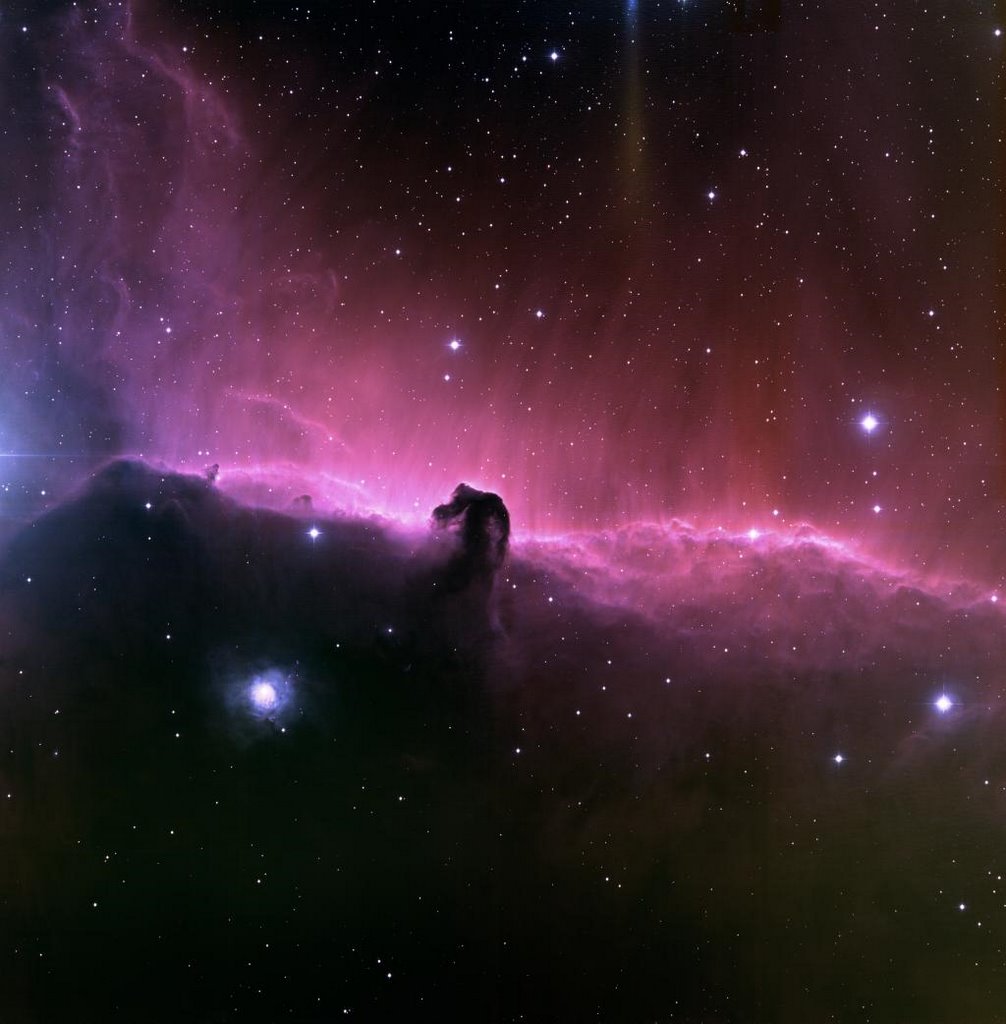
5. Horsehead Nebula
The dark area that makes up the head is a dark nebula - a thick cloud of hydrogen gas and dust where new stars are being formed. The nebula can be seen here only because it blocks out the light of the emission nebula behind it.


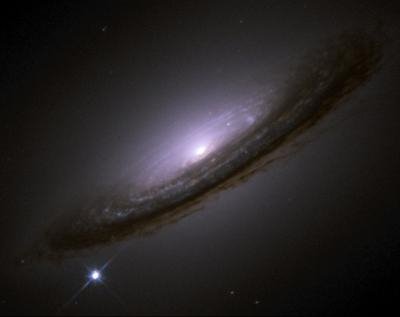
6. Supernova 1994D in Galaxy NGC 4526
Supernovae are massive explosions, often the dying moments of a massive star (although SN 199D is a type 1a supernova, caused by an explosion in a white dwarf star). They shine only briefly but for those few days may outshine the galaxy in which they reside! Supernovae are hugely important 'creation' events, as the force of the explosion forms many of the heavier elements, blasting them into space. (Fusion in stars forms elements up to iron on the Periodic Table, but heavier elements, e.g. copper, tin, silver, gold, are not formed by fusion.)


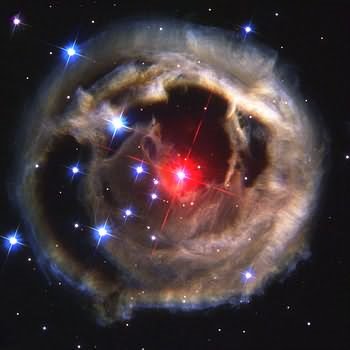
7. Light echo from Red Supergiant V838
This picture is one of a dramatic series of images taken by the Hubble telescope in early 2002 and showing a sudden brightening of star V838 Monocerotis, lighting up the dust clouds around it. It is called a light echo because the pictures show a ring of illumination gradually expanding around the star as the light travels outwards.


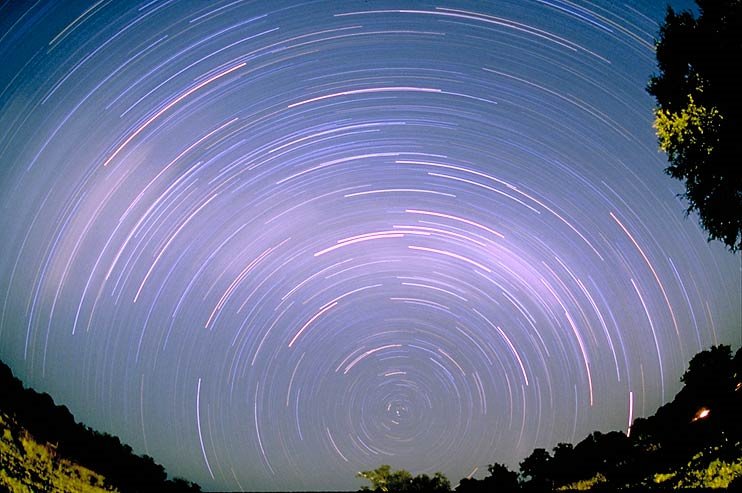
8. ...a picture I would love to take!
Images like this always stump the kids..even when they should know the answer!
I'm sure you'll figure it out straight away.. but can anyone work out the exposure time?


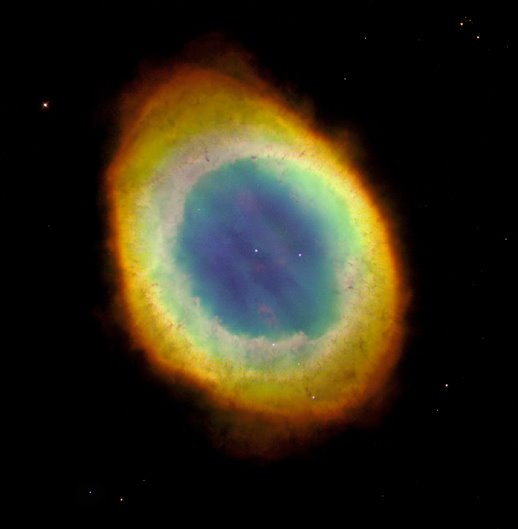
9. The Ring Nebula, in the constellation Lyra
This is one of the most famous Planetary Nebulae, the gas and dust drifting away from the white dwarf (seen in the centre of the image) left behind at the end of a star's life. This is an almost true-colour image, the colours are from the different elements glowing in the dust (blue - hot helium, green - ionized oxygen, red - ionized nitrogen).


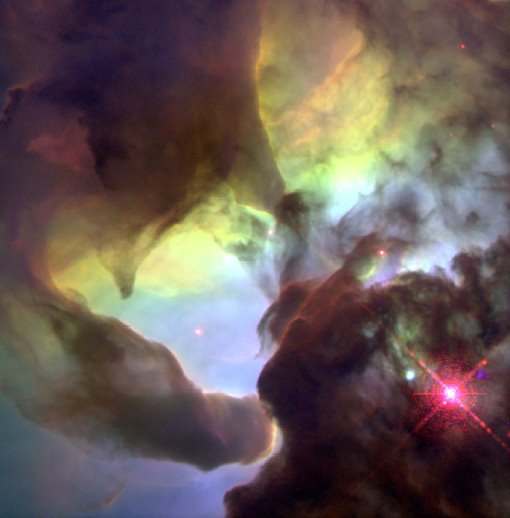
10. Twisters in the Lagoon Nebula
The Lagoon Nebula is one of only a few nebulae visible to the naked eye in the Northern Hemisphere and can be seen in the constellation of Sagittarius. Check out the larger picture and explanation.


(Note: all these pictures - except the star trails - are from NASA and therefore copyright-free)

Tuesday, November 29, 2005

Laughably conservative?

I enjoyed this quote by Arthur C Clarke (Google's 'Quote of the Day' today):

"If we have learned one thing from the history of invention and discovery, it is that, in the long run - and often in the short one - the most daring prophecies seem laughably conservative."

I wondered how many other predictions will end up being seen as 'laughably conservative'. Our conceptions of God, the universe, heaven.. just for starters!

Saturday, November 26, 2005

A non-trivial congruence - or the real beauty of Mathematics

Something I often find myself struggling to explain is the concept of mathematical beauty. It's something that mathematicians and physicists instinctively recognise, but it's not easy to articulate to the lay person!

But I was most heartened to find the following excerpt on John Polkinghorne's website (a wierd site set-up means it's impossible to link straight to the article). He doesn't answer the question of beauty per se but he makes a most appealing case for the amazingness of mathematics generally!

He's discussing aspects of metaphysics... 'aspects of the laws of physics which raise questions beyond physics' competence to answer':

"The first is a property of the physical world that is so familiar to us that we take it for granted. It is, in fact, the necessary basis of the whole scientific endeavor. It is this: that we can understand the world, that it is intelligible to us, that it is rationally transparent. Not only do we understand the world, but it is mathematics which is the key to the understanding of the physical universe. In fundamental physics one looks for theories which in their mathematical expression are economic and elegant, which are mathematically beautiful. Mathematical beauty is a very recognizable characteristic. There is an expectation -- an expectation that has been justified time and again in the history of physics -- that it is just those theories which have the character of mathematical economy and elegance which will prove to be the ones that explain what is going on in the physical world. If you have a friend who is a theoretical physicist, and you wish to upset them, you simply say to them, "That new theory of yours looks rather ugly and contrived to me." They will be truly upset, because you are saying that it does not have the character which successful theory always has had.

When we use mathematics in that way as a heuristic tool, a device for finding out what's going on in the world, something very odd is happening. After all, what is mathematics? Mathematics is the free exploration of the finite human mind. Our mathematical friends sit in their studies and out of their heads they spin the beautiful patterns of mathematics. Mathematics can be thought of as a pattern creating, pattern analyzing, subject. Yet some of the most beautiful patterns that are dreamt up by the pure mathematicians in their studies are found actually to occur in the structures of the physical world around us. In other words, there is a deep-seated congruence between the reason that we experience within (in our minds) and the reason that we experience without (in the physical world around us). They fit together like a glove. That seems a fact about the physical world that is what the mathematicians in their modest way would call non-trivial. 'Non-trivial' is a mathematical word meaning 'highly significant.'"


Wow wow wow (or is it just me?!) I love this guy!

Polkinghorne discovered

I was introduced a couple of days ago to John Polkinghorne, someone I can't believe I've missed up to now! Definitely someone I'd like to be more acquainted with. Originally a theoretical physicist and a professor at Cambridge, now an Anglican minister working at 'the interface between science and religion'. I really liked his website - the Q & A section makes really interesting reading. It's great to find someone speaking intelligently and passionately about subjects so close to my heart!

Friday, October 28, 2005

Food for maths geeks

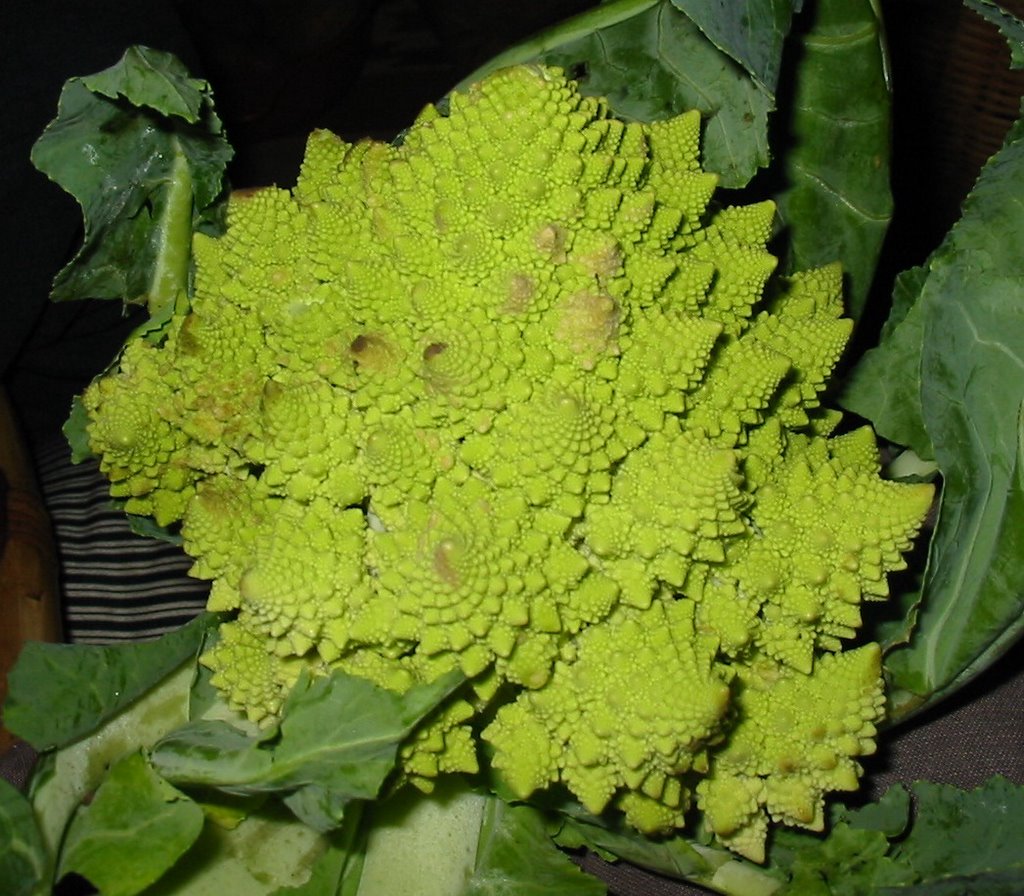
This strange cauliflower turned up in a bag of organic vegetables. We were quite stunned but I have since discovered that it is not of extra-terrestrial origin but in fact a 'Broccoli Romanesco'.
This veg must be the best example of a natural fractal that I have ever seen! My picture's not great but this website has some excellent pictures and explanation.

Thursday, August 25, 2005

Magic Number 1

And now for a bit of maths...
(I continue to be fascinated with the strange results of probability theory..see the Monty Hall problem)

Did you know... if you take any large set of numerical data from randomly selected statistics (importantly, not 'pure' random numbers) then the number 1 will appear as a leading digit about 30% of the time.

The man who first brought this to light was called Dr. Frank Benford, and thus this strange result is called 'Benford's Law'. It is used in accounting to detect fraud, because, for a non-fraudulent set of accounts, running all the figures through a computer will give the result above - the number 1 appears as the leading digit (e.g. 13.00, 1.15, 1602.38) 30% of the time. A result that is significantly different from this and it's time to call in the auditors!

Check out this page for a fuller description. A nice demonstration of why this is the case can be found at the bottom of the page.

Freedom and Uncertainty

We were having a discussion last night at dinner about freedom and uncertainty in the universe. I was reflecting on what the Heisenberg Uncertainty Principle (HUP) implies about the universe as created by God.

For those unfamiliar with Heisenberg’s theory, it’s this:
The more precisely the position [of a particle, e.g. electron] is determined, the less precisely the momentum is known in this instant, and vice versa.”

In other words, you cannot know both a particle’s position and its movement at the same time. In the quantum world, you must speak in probabilities. For example, as this website helpfully explains:
I can only say that an atom will be at some location with a 99 % probability, and that there will be a 1 % probability it will be somewhere else (in fact, there will be a small but finite probability that it can even be found across the Universe).

Heisenberg was primarily concerned with measurement. His principle implied that previously certain Classical ‘realities’, such as speed, direction, mass, position, were meaningless in the new quantum world and he argued that some aspects come into existence only as they are measured. ("The 'path' comes into existence only when we observe it.") In this way, the uncertainty at the heart of the quantum world is not a result of our poor measurement technique, but an integral part of the universe itself.

This had massive implications, not least for Newton’s idea of causality. In simple terms, the classical view was that if the position and momentum of every particle in the universe could be determined, then you could predict the path of each based on the forces acting on it, i.e. predict the future. Of course, to Newton, only God could possibly have the observational and computational power to accomplish this. But, as Heisenberg pointed out: "In the sharp formulation of the law of causality—‘if we know the present exactly, we can calculate the future’-it is not the conclusion that is wrong but the premise." Essentially, what he’s saying is that it’s impossible to know the present exactly (but the limit is not on the knowing, but on the ‘exactly’).

The question I asked is, since the uncertainty principle seems to be part of the very fabric of the universe and an integral characteristic of quantum particles, is the universe ‘uncertain’ even to God? In the same way as He’s given us freedom, has He built a similar freedom into the physical universe?

Dad is reading Greg Boyd’s ‘Satan and the Problem of Evil’ and was similarly reflecting on what it meant for humans (and angels) to have real freedom, and the necessary uncertainty built into that.

Thoughts anyone?

(Quotes are taken from this website where you can also read more about Heisenberg)